Why More Women Are Choosing Freebirth
And why the system needs to look in the mirror
Many women consider birthing without a midwife for a wide range of reasons.
For some, it’s philosophical.
For others, it’s a practical balance of the options.
For many, it’s a deeply personal gut feeling.
What’s becoming increasingly clear, though,
is that the recent rise in freebirth is not happening in a vacuum.
In many cases, it is directly linked to the loss of skilled,
reliable homebirth services and the erosion of trust in maternity care.
Across the country, homebirth provision has become patchy and unpredictable.
Women are asked to plan a homebirth without any certainty that a midwife will actually be available.
Services are suspended at short notice.

In some areas, homebirth is just quietly discouraged
or made so difficult that women are effectively pushed elsewhere.
Whether or not trusts acknowledge it,
blanket suspensions are unlawful.
But legality aside,
the impact on women is very real.
Birth is governed by physiology,
and physiology is governed by safety.
A woman’s body needs to feel safe for labour to begin and progress well.
When safety is removed—through uncertainty, fear,
or last-minute disruption—the consequences are not abstract.
In Gloucestershire alone,
I have spoken to three women who were informed shortly before their due dates
that their planned homebirth service was being suspended.
All three experienced sudden,
significant rises in blood pressure soon afterwards.
High blood pressure is dangerous for both mother and baby.
This is not a coincidence.
This is harm being caused by the system itself.
For other women, the issue is not availability but intrusion.
Many do not want the risk of a stranger turning up at their home while they are in labour.
Trained or not, the subconscious does not distinguish between “professional” and “unknown.”
A stranger can be perceived as a threat, and during birth, perceived threat matters.
Informed women understand this.
They know that unfamiliar people can disrupt labour,
undermine autonomy, and in some cases escalate intervention.
That doesn’t mean midwives are the enemy. Far from it.
Midwives are often extraordinary.
Skilled, intuitive, deeply committed.
But they are now working inside overstretched,
fear-driven systems where they are no longer free to practise with women.
Instead, they are expected to enact policy, manage risk, and protect institutions.
Some midwives are sent to homebirths after 30-hour shifts.
Others are hospital-based staff who have never attended a homebirth before.
Women know this.
They are expected to open their homes, their bodies,
and their most vulnerable moments to someone whose experience and wellbeing they cannot assess.
In response, many women ask midwives to sit in another room and take a “just in case” role.
It’s easy to see why midwives dislike this.
Their role has been stripped back to medical necessity alone.
But from the woman’s perspective, what is the alternative?
To hand over her birth to a stranger she has never met,
within a system she does not trust?
This is not a safe system.
So some women, after long periods of research and soul-searching,
decide that freebirth is the safest option for them.
These women are often well-educated, well-prepared,
and well-resourced—though none of that should be a prerequisite for bodily autonomy.
Women have been giving birth since time immemorial.
At the same time, we live in a modern world with modern challenges,
and each woman must weigh those realities
and make a plan that fits her life, her body, and her values.
That plan might include a doula, a birthkeeper,
an independent midwife,
or—where it is possible—a known NHS midwife.
It might also include contingency planning.
Contrary to popular belief, most women do not have rigid,
absolute birth plans.
Freebirth is rarely an “all or nothing” position.
We are also fortunate to live in a country with excellent emergency services.
Even within the NHS, there are compassionate professionals who quietly support women’s choices.
In areas with strong community homebirth teams,
some midwives will even provide women planning a freebirth with a direct number to call if something doesn’t feel right.
Yet despite this, parts of the medical establishment continue to act as though women are the problem.
Birth plans are dismissed or mocked.
Women are told — often during labour —
that there are “concerns” about the baby
and that interventions must be accepted.
Questioning this logic while in labour
is incredibly difficult.
What is clear, however,
is that around half of all women
do not need caesarean sections.
And the growing loss of trust
in maternity care
is not something women have invented.
It is the result
of lived experience.
Women talk. They always have.
Now they talk online,
in groups,
across borders,
sharing stories
and noticing patterns.
The profession may not like what is being said.
But blaming women — calling them fat,
old,
or inherently risky —
only deepens the divide.
Most people agree that modern medicine is extraordinary
when used appropriately.
The problem is not medicine itself.
The problem is overuse. Coercion.
And a system that cannot recognise what it is getting so wrong.
The truth is this: we are lucky.
The law in this country is on women’s side.
We can choose where we give birth, how we give birth,
and who we give birth with.
That freedom does not exist everywhere.
We also have choices.
We can draw on community support.
Hire a doula or birthkeeper.
Or — if finances allow, and sometimes family are willing to help —
work with an independent midwife.
And for those who are pregnant, curious, involved in birth,
or already attending births and wanting a refresh:
This is exactly why
the Homebirth Emergencies course exists.
It’s friendly. Factual. Down to earth.
Not fear-based. Not ideological.
Just honest education, rooted in reality.
Because women deserve safety. Real safety.
Not the kind written in policy documents —
but the kind the body recognises.
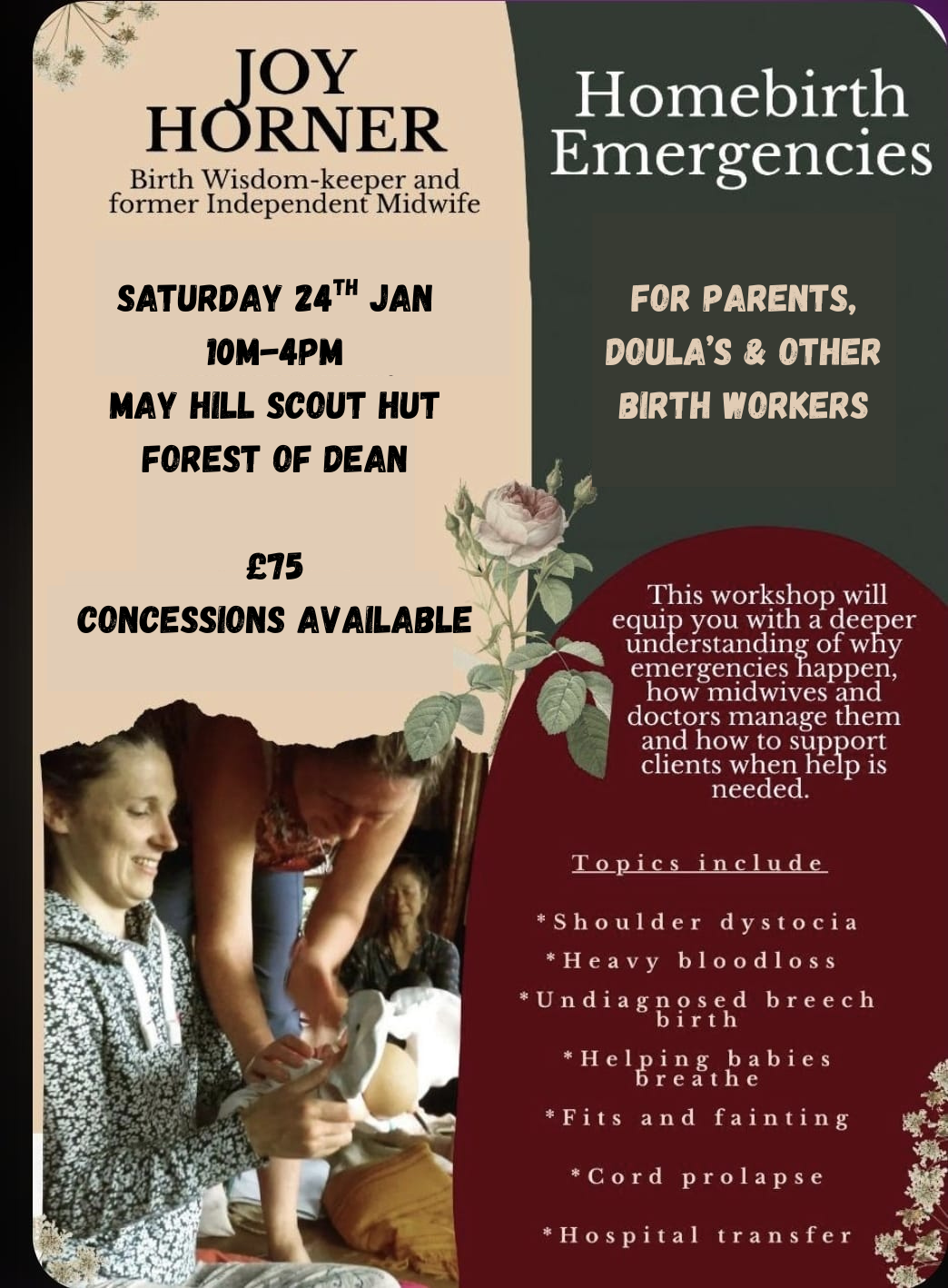
Joy Horner is an experienced, retired Independent Midwife, now Doula and trainer.
This 1 day workshop is for parents, doula’s and birthkeepers alike who either want to learn or refresh themselves about the problems that can occur during homebirth and what immediate action can be taken whilst waiting for medical help.
Information is presented in a practical and supportive format, with real life stories.
This does not replace, but rather supplements a baby / newborn first aid course and does not replace medical advice.