
Gloucestershire Homebirth Suspension: FOI on Safe Staffing, Budget & Questions That Still Need Answering

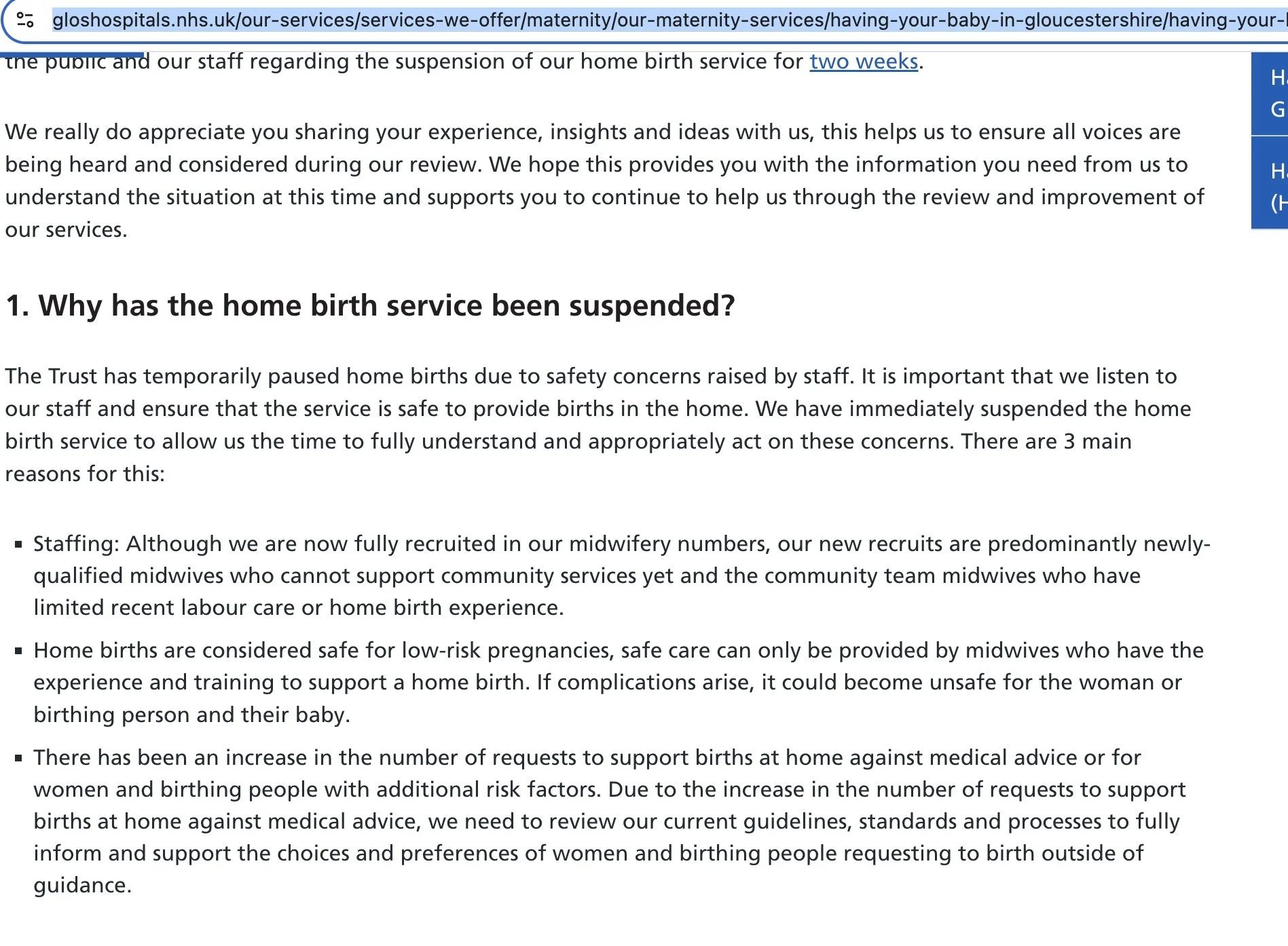
In November 2025, Gloucestershire Hospitals NHS Foundation Trust suspended planned home birth services across the county.
For many women and families,
this decision removed a safe, lawful,
and deeply valued maternity option overnight.
Home birth is not simply a lifestyle choice.
It represents continuity of care,
better safety outcomes for women,
remaining just as safe for their babies
(with lower incidence of NICU transfer)
Women make these choices based on decades of sound research.
(Unlike many NHS Guidelines & decisions)
The Trust’s explanation for the suspension was staffing pressures.
But over the past few months I have submitted a series of Freedom of Information requests to understand how this decision was made.
The responses have raised some serious questions.
Staffing shortages
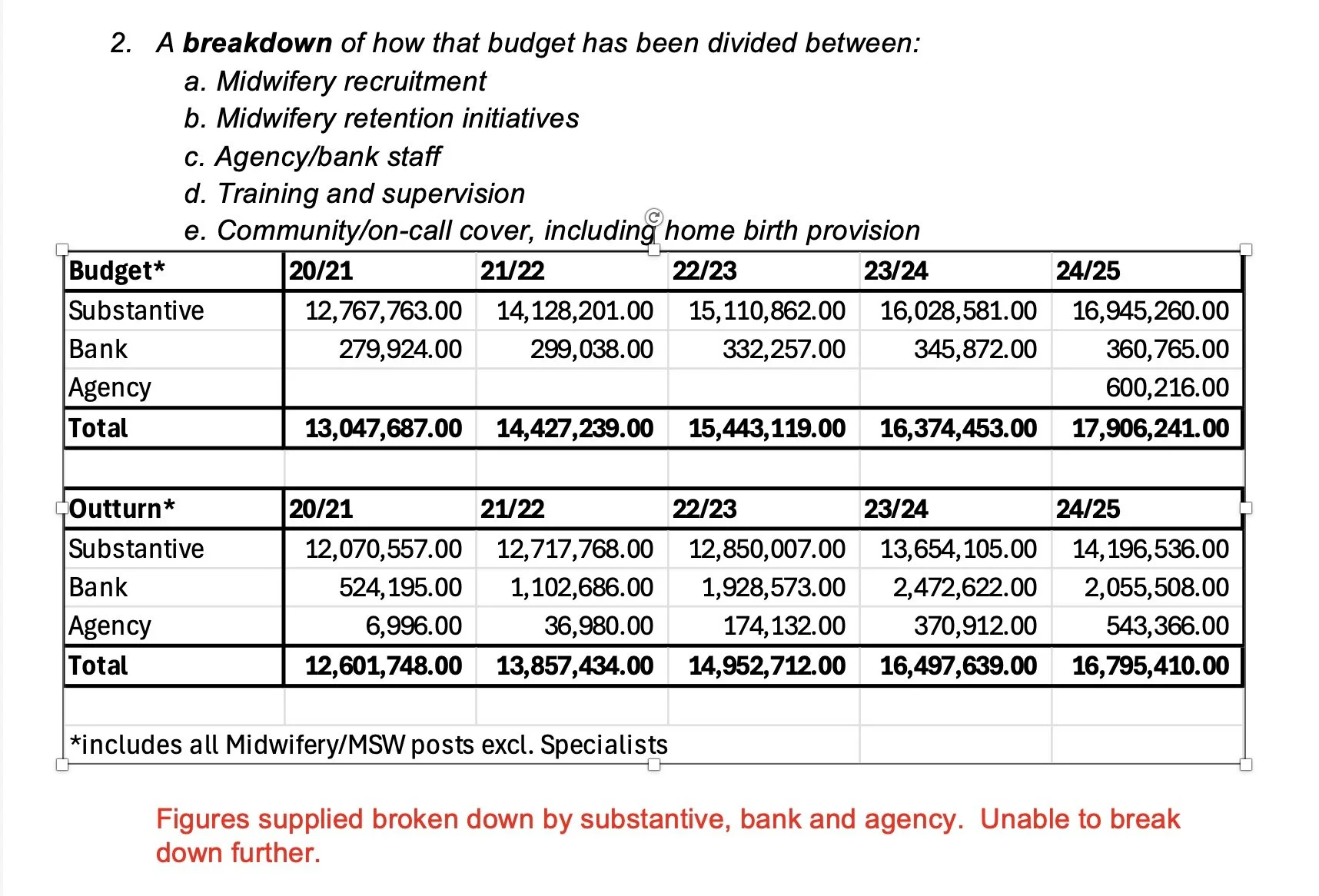
— but staffing budget underspend
Documents released under the Freedom of Information Act indicate that the Trust had a significant underspend in its maternity staffing budget during the relevant period.
(Over £1M staffing underspend in 24/25)
If a service was removed because staffing levels were unsafe,
it is reasonable to ask why a substantial portion of the staffing budget was not used.
This contradiction alone deserves explanation.
A risk assessment still “going through governance”
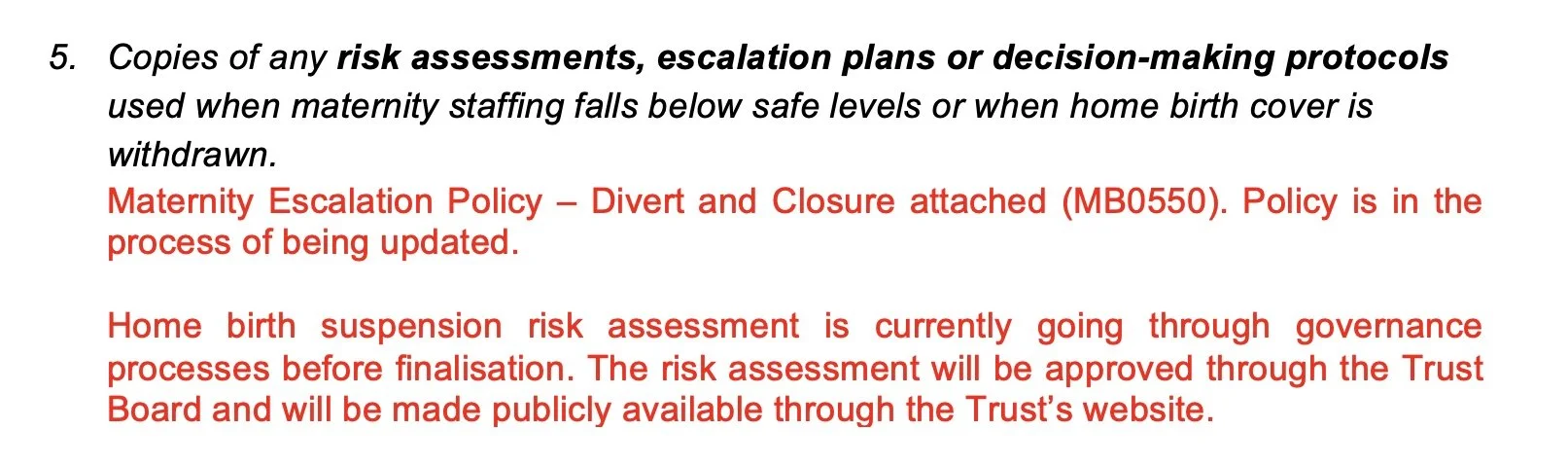
Another response from the Trust states that the risk assessment relating to the home birth suspension is still going through governance processes before finalisation.
Yet the decision to suspend the service was taken on 17 November 2025.
Normally, risk assessments are the documents used to inform decisions like this.
If the risk assessment was not finalised at the time the decision was made,
it raises questions about what evidence or governance process informed the suspension.
Missing documentation relating to maternity safety supervision
Further Freedom of Information requests asked for documentation relating to A-EQUIP, the national framework introduced by NHS England to support reflective supervision and safety learning within maternity services.
The Trust responded that it holds no records of correspondence or assessments relating to A-EQUIP implementation or Professional Midwifery Advocate supervision discussions connected to maternity staffing safety or service changes over the past five years.
Given that A-EQUIP is designed to support safety culture, staff reflection and governance learning within maternity services, the absence of recorded documentation is surprising.
A small service with possible alternatives
The Trust has stated that demand for planned home birth locally is around six women per month.
Independent midwives — who are regulated professionals registered with the Nursing and Midwifery Council — have been commissioned by other NHS trusts in England to maintain continuity of care when services face temporary workforce shortages.
If the number of women requesting home birth is small, and funding exists within the maternity staffing budget, it is reasonable to ask whether alternative arrangements could have been explored before removing the service entirely.
Seeking transparency and accountability
In response to these findings, I have taken a number of steps to seek clarification and oversight.
Internal review requests have been submitted to the Trust regarding the Freedom of Information responses.
Concerns have also been raised with the Care Quality Commission, which regulates the safety and governance of healthcare providers.
The matter has also been brought to the attention of NHS Gloucestershire Integrated Care Board, the statutory body responsible for commissioning maternity services for the population of Gloucestershire. A public question has been submitted to the Board asking what oversight was exercised over the suspension decision.
Information relating to these governance concerns has also been shared with **NHS England, which oversees national maternity safety frameworks.
Public healthcare is supposed to be transparent and accountable.
Public trust depends on decisions being made through
clear evidence, proper governance and lawful processes.
When services are removed
— particularly services that affect women and families at one of,
if not THE MOST the most vulnerable and transformative moments of life
— the reasons for those decisions must be transparent and accountable.
At the moment, the documents released raise more questions than answers.
Those questions deserve careful and open scrutiny.
Scrutiny and democratic oversight
Concerns about the suspension of home birth services have also been raised with the county council’s Health Overview and Scrutiny Committee (HOSC), which has statutory powers to scrutinise NHS service changes and hold local health bodies to account.
Many families and advocates hoped the committee would use those powers to examine the evidence behind the suspension and ensure that lawful processes had been followed.
However, to date the committee has not used its scrutiny powers to investigate the governance issues raised by the Freedom of Information responses.
This lack of scrutiny has been deeply frustrating for many families affected by the decision, and it raises wider questions about how democratic oversight of local health services is functioning in practice.