What does tanning a fish skin have to do with rewilding women? Far more than it might seem.
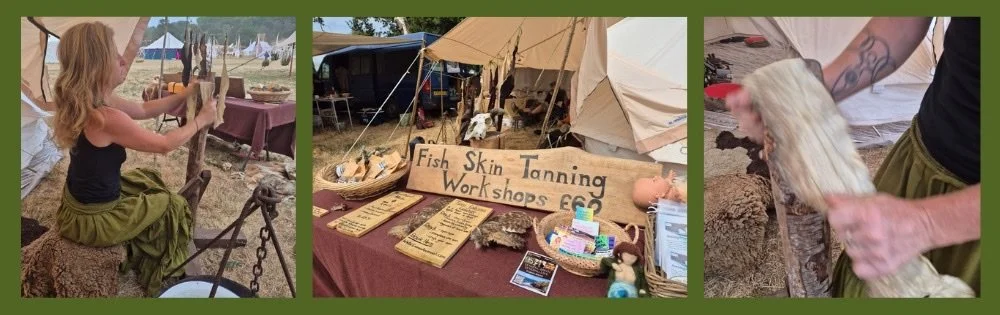
This summer, I took fish skin tanning and other animal crafts to Medicine Festival for the first time.
It was the biggest festival I have ever worked at. I heard that around 7,000 people passed through over the course of the week, and the scale of it was quite something to find my way around. It was also held in the middle of a drought, on a beautiful but physically demanding site, during extraordinary heat.
It was tough at times. There is no point pretending otherwise.
But over the week, we met some truly amazing people: the other makers working around us in the craft area, the people who came to take part, and those we met in the small, unexpected corners of the festival where so much of the real magic seemed to happen.
Finding our feet in the heat
The craft area was a little slow at times. As a first-time facilitator at such a huge event, though, I was secretly rather grateful not to be completely overwhelmed—especially in that heat.
The booking system meant that I could group people together, so instead of constantly beginning again, we could gather around the work and learn alongside one another. It created space for conversation, curiosity and connection.
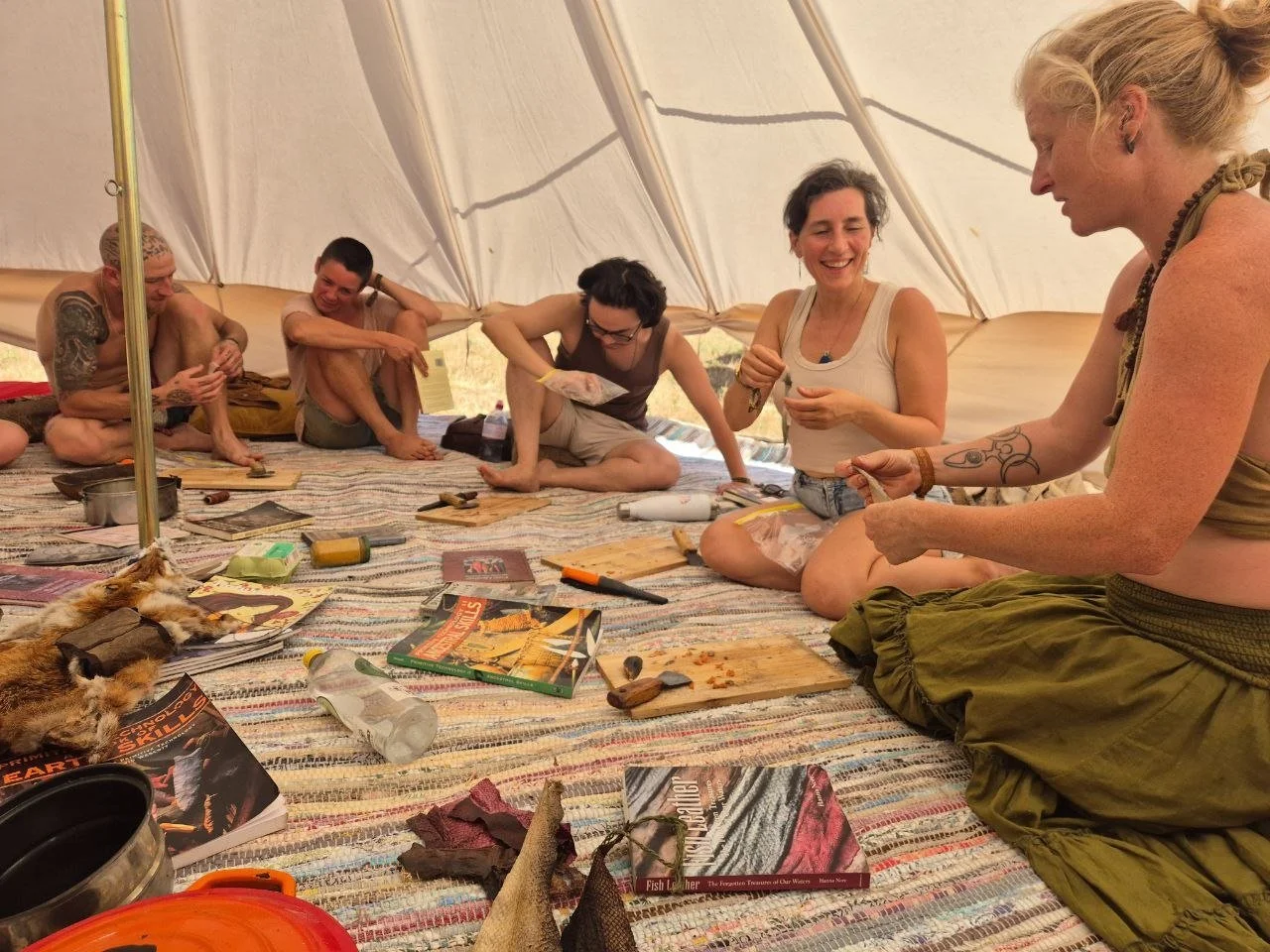
I was asked a number of times whether I run these workshops at home in the Forest of Dean.
The answer is: I would love to.
Thirty women at nine in the morning
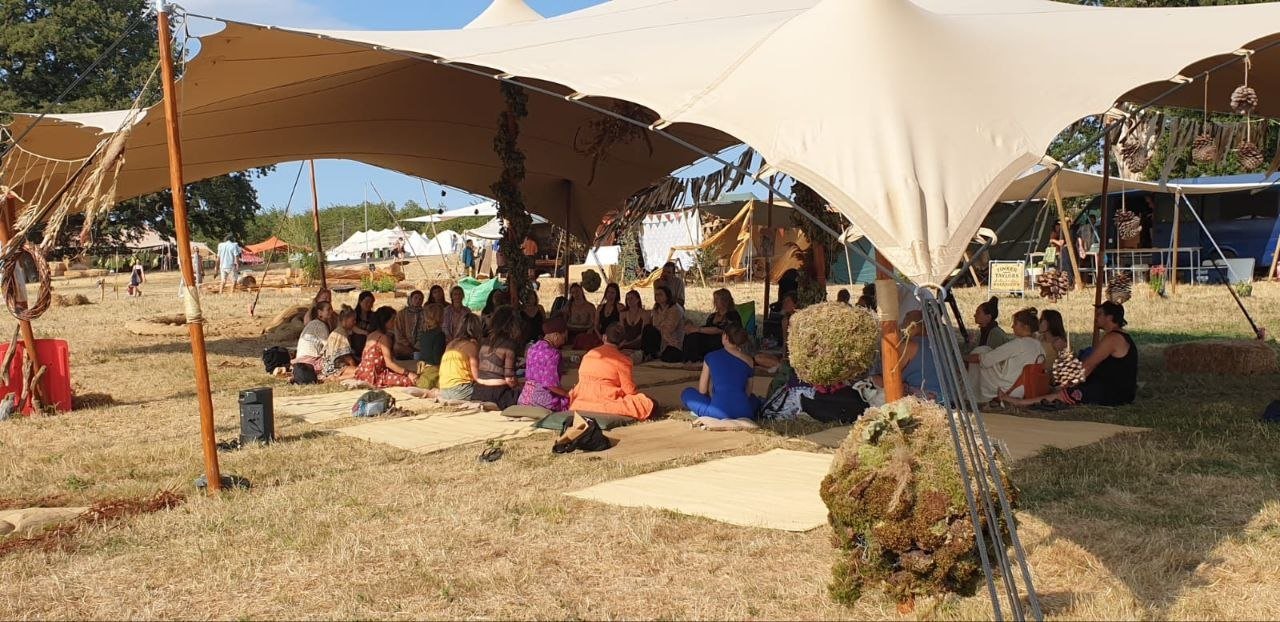
Medicine was also where I offered the first of this summer’s Closing the Bones workshops—and it truly bowled me over. I came away almost dumbfounded by what had happened.
I had not realised until I arrived that the workshop was only an hour long. My first thought was: This is impossible. How can I possibly share Closing the Bones in one hour?
Then women began arriving.
It was nine o’clock in the morning, at a huge festival, with so many big names, and amazing women from around the world holding spaces & ceremonies… yet around thirty women made it their mission to come and take part.
As more and more women entered the space, I wondered how on earth it was going to work.
But I held my nerve. We sat in a circle, and I thanked them for answering the call.
I reminded them that this does not belong to me. The Mexican and Brazilian women who have shared these practices with me have told me that they are a gift to the world, to be passed on. And so I humbly offered the women gathered there some of the skills that have been shared with me.
I spoke a little about the origins of the rebozo and the understanding of it as an extension of the heart. The Abuelas and Parteras who had come to the workshop offered their blessings and helped to guide the women. A South African birthkeeper shared some of her own knowledge: that following a loss, a woman may be wrapped from her feet upwards rather than from her head downwards, and that different colours may carry particular meanings.
Women from different countries and traditions were not competing to own the practice. Knowledge was moving around the circle, offered with generosity and received with respect, which still brings a tear to my eye.
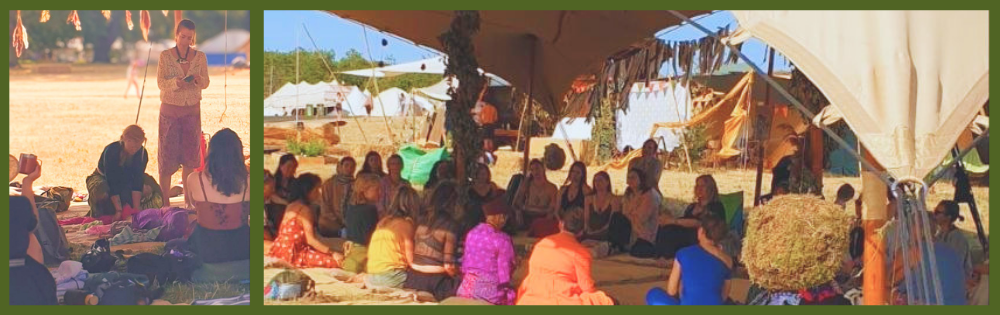
For the following two days, women stopped me around the festival and came to our stall to say that the workshop had been the highlight of their Medicine experience. They told me how well held and facilitated they had felt.
Honestly, I still do not quite know how I did it. I had not rehearsed it deeply or constructed a perfect plan.
It felt as though the knowledge was moving through me. I knew what needed to be shared, and I trusted it.
Perhaps the reason thirty women came at nine in the morning is that this remembering is not niche or obscure. It is important—and women recognise it. They know it in their bones.
Rewilding women through animal craft
My work is about rewilding women—not as a fashionable idea, but as a process of returning to a more natural state. Undomesticating ourselves. Remembering our instinctive nature and rediscovering what our hands and bodies already know.
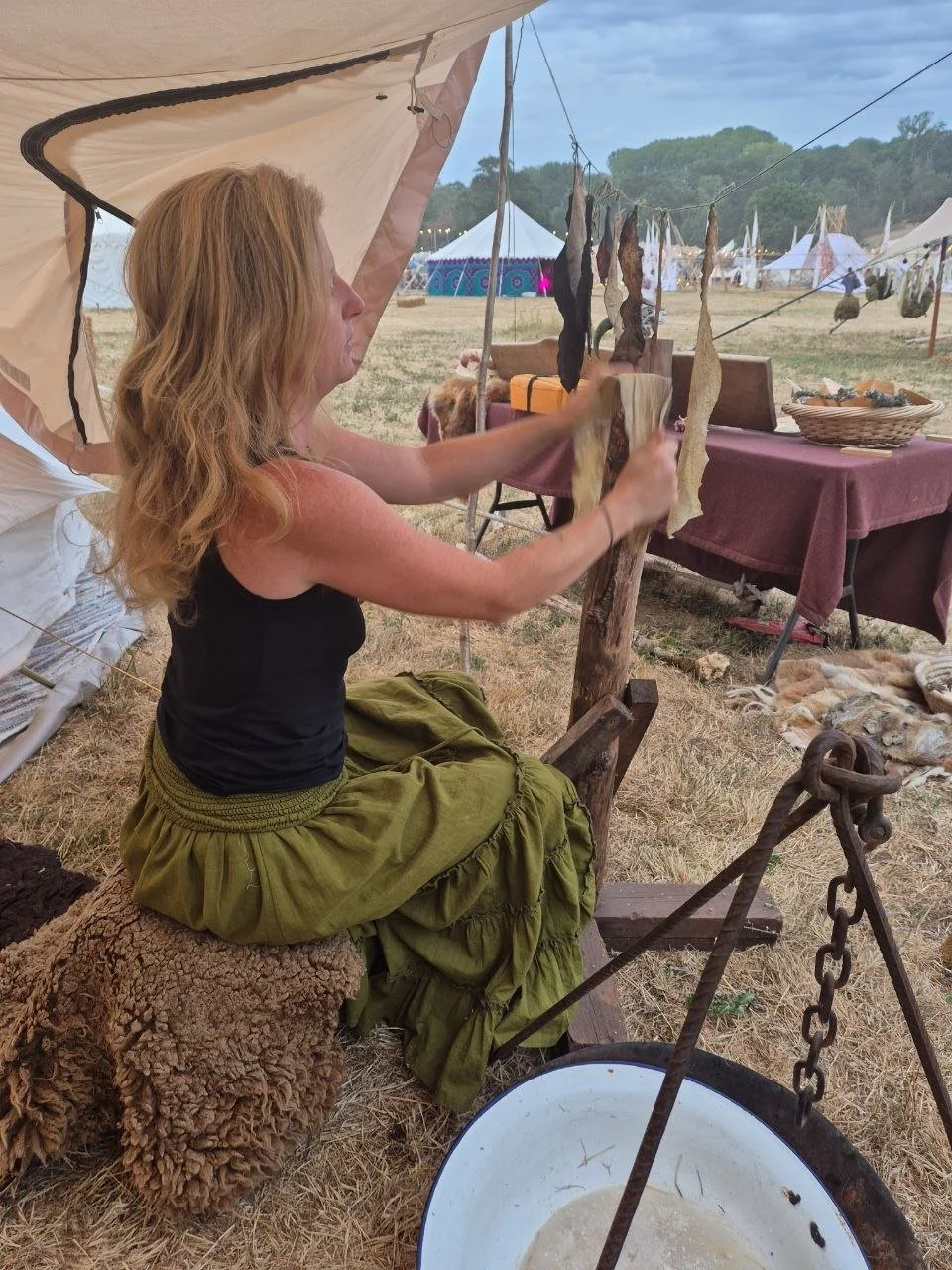
The animal work I offer is a powerful part of that.
I do not really need to teach someone how to skin an animal in the way we usually understand teaching. I show her how to begin.
I make the space safe enough.
I give her permission to touch, explore and feel her way into the process.
And then she does.
Time and time again, I watch women move from uncertainty or squeamishness into complete absorption. Their hands begin to understand. They stop looking to me for every answer and start trusting what they can feel. Something ancient and instinctive wakes up.
This is not about becoming hardened or disconnected. Quite the opposite. It asks us to come into a more honest, reverent and intimate relationship with the animal, the material and ourselves.
Coming face to face with death
Sometimes this work is centred around grief.
I have held grief ceremonies because I believe it is important to honour the death of a being. When we work with a skin, we cannot pretend that death has not happened. We meet the reality of it with our own hands.
In modern life, death is usually kept carefully out of sight. Animal products arrive cleaned, cut, wrapped and labelled. The difficult parts have been done elsewhere by someone we never have to meet. Even lifestyles and products presented as death-free can hide the habitats lost, animals displaced, creatures poisoned and ecosystems damaged in their production.
We are all responsible for some degree of death and destruction simply by being alive. Nothing can be born, grow or be sustained without something else changing, ending or dying. We cannot separate ourselves from that cycle, however neatly we package our lives.
Having death brushed under the carpet is dangerous, in my opinion. It does not make us kinder. It simply makes us less conscious of what our lives require.
This is one reason I believe this work matters.
Animal craft offers a different relationship: one rooted in attention, gratitude, responsibility and use. We do not turn away from the animal’s death, but neither do we waste what remains. We acknowledge it, learn from it and transform it with care.
Grief can be part of that transformation. So can wonder, curiosity, discomfort and even joy. There is room for all of it.
The hidden corners of Medicine
As the week unfolded, I began to discover the smaller spaces tucked within the huge festival site: the nooks and crannies where intimacy and connection could still happen.
The Nightingale’s Nest was a beautiful little folk-music space.
Ceredigion’s Cauldron held another kind of magic, close to an area where many of the women’s workshops were taking place. These were some of the spaces in which the enormous scale of Medicine fell away and it became possible to feel part of something smaller.
And I got to meet Kemi Birthjoy Johnson—what an absolute legend. I went along to her workshop and loved having the opportunity to meet one of the celebrities of the birth world in person. She was every bit as wonderful as I had hoped. In the middle of this enormous festival, getting to sit in the space held by a woman whose work I have known and respected felt very special indeed.
That was an important part of my first experience: learning not only how to offer my own work there, but how to find the festival within the festival.
Walking the path once
If I am invited, I will return to Medicine in two years’ time.
Next time I will arrive having already walked the path once. I will know more about the site, the rhythm of the week, the practical demands and the places where the quieter magic happens. I will bring everything that this first experience has taught me.
There is something valuable in being new, though. I had to find my feet, adapt and allow the experience to be what it was. The workshops did not need to be packed from morning until night to be worthwhile. The women who came found something in the work, and I found greater clarity about why I offer it.
Bringing these workshops home
The questions people asked at Medicine have planted a seed.
Would you come to a fish skin tanning workshop in the Forest of Dean or close to where you live?
Would you like to learn rabbit skin tanning, join a women’s animal-craft circle, or gather for a grief ceremony that allows death and loss to be honoured rather than hidden away?
I would love to begin offering more of this work.
I feel increasingly that I am in service to the world, with all of my gifts available to be passed along.
I am not here to position myself as the keeper of knowledge that belongs only to me. I can help you begin, share what I have learned, hold the space and give you permission to trust your own hands.
The knowing is already there.
Sometimes we just need someone to help us remember.
If you would be interested in a fish skin tanning workshop, rabbit skin tanning, women’s animal craft or a grief circle in the Forest of Dean, or elsewhere please get in touch and tell me what is calling you.
I would love to hear from you.